Starting as a Japanese manga series, Afro Samurai can be described as a pop-culture concoction that merges big hair, martial arts, feudal Japan, blaxploitation, and techno-infused hip-hop. Needless to say, the end product is an interesting mix. But does it all come together to make a great video game?
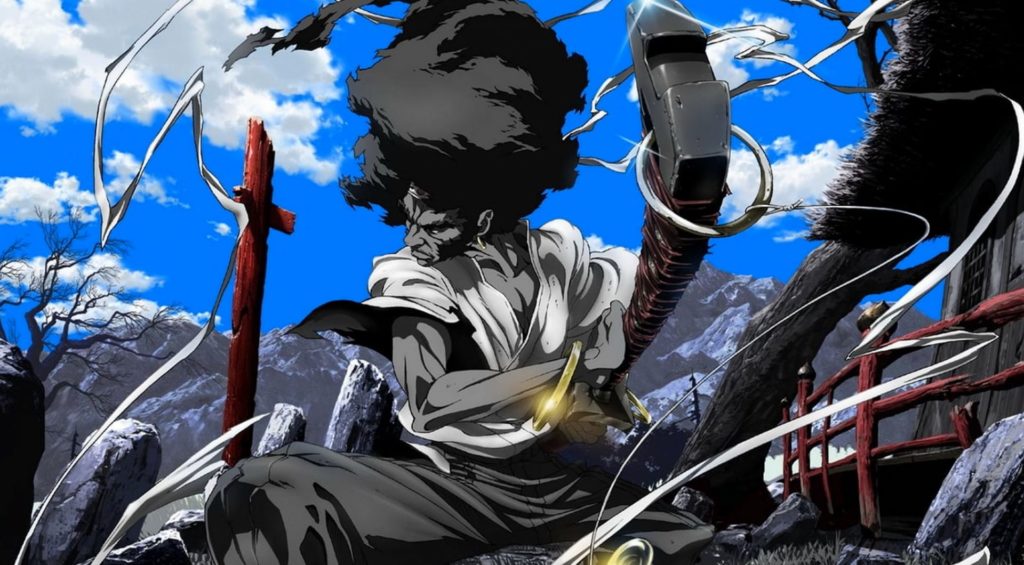
Namco Bandai’s approach to this third-person hack-and-slash title manages to capture the essence of the cult series created by Takashi Okazaki. In fact, the game looks like it has come straight out of the pages of a comic book thanks to its stylish cel-shaded rendering. Unfortunately, Afro Samurai reminded me of Jennifer Love Hewitt — it may look gorgeous on the outside, but once you start engaging with it, things feel somewhat broken on the inside. More on that later (Afro Samurai’s faults, not Jennifer Love Hewitt).

The international popularity of Afro Samurai is made clear through its Hollywood voice cast. Samuel L. Jackson voices the titular role, alongside Ron Perlman (Hellboy) and Kelly Hu (The Scorpion King, who also provided voice work in Star Wars: Knights of the Old Republic), all delivering impressive performances. Jackson voices both Afro Samurai and his alter ego Ninja Ninja, and his dialogue feels perfectly written for him. His trademark swearing and smart remarks are scattered throughout the game, and at one point I half-expected him to shout, “Get these mutha ***** snakes off my mutha ***** plane!” Afro himself is relatively quiet, but as Ninja Ninja — Afro’s guide and inner voice — his sarcastic banter fits the game perfectly. Fans will not be surprised by his involvement, as Jackson also starred in the English dub of the Afro Samurai anime series.
The high-quality voice acting is supported brilliantly by the game’s musical score. Hip-hop beats mixed with ethnic influences suit the tone well, often increasing in tempo just as you enter combat with waves of ninjas.
As mentioned earlier, Afro Samurai is a visually striking piece of art, featuring compelling cel-shaded characters complemented by cross-hatched details and photorealistic backgrounds. The color palette is mostly muted, using greys to create a dark and ominous atmosphere that suits the game’s tone. Even the storytelling borrows from grindhouse cinema, using split-screen moments to show events happening simultaneously without interrupting the action. For example, while fighting, another panel may appear showing enemies approaching from behind. The loading screens also reveal fragments of the story through dream-like visions of Afro’s past. The storyline may be confusing for newcomers, especially Afro’s quest for a mystical headband said to rule the world, but it never fully detracts from the experience.
At this point, you may be wondering how the game actually plays. Unfortunately, the gameplay does not live up to the strong presentation. Part of this stems from the HUD-less design, chosen to enhance cinematic immersion. While visually pleasing, it can be frustrating when you need basic information such as your health or objective. Pressing down on the D-pad summons Ninja Ninja to guide you, but if you are facing the wrong direction, finding him can be awkward. Health feedback relies on audio cues and visual blood stains, yet the transition from healthy to near death often feels abrupt.
Combat itself is well implemented and stands among the better hack-and-slash systems available. Controls are simple, offering light, heavy, and kick attacks, along with blocking, parrying, and a Focus mode. While slow-motion mechanics are nothing new, Afro Samurai’s Focus mode is visually impressive. As you build Focus through combos, time slows, the world fades into greyscale, and a line appears to show where your sword will strike. This allows for precise, gory finishing moves, such as slicing enemies in half or severing limbs. The visuals alone make these moments satisfying, even without the additional reward of achievement points.
Cutting through standard enemies remains enjoyable, but the game also introduces a colorful variety of foes. These include towering brutes wielding massive weapons, Ronin willing to commit hara-kiri, and heavily tattooed, scantily clad female ninjas. It is worth noting that Afro Samurai carries an R18 rating.
The biggest flaw, unfortunately, lies with the camera. During combat, it often fails to capture all the action, leaving enemies off-screen. Platforming sections can also be frustrating when unseen gaps cause missed jumps. Oddly, camera settings cannot be adjusted during gameplay and require returning to the main menu. Even after tweaking, there are moments where the camera simply refuses to cooperate.
Despite these issues, Afro Samurai remains an entertaining visual experience. Its aesthetics are consistently impressive, and when everything clicks, the game delivers moments of stylish, gory spectacle. Thanks to Samuel L. Jackson’s humor, it never feels like it is trying too hard to be cool.